
Iosco Parole and Probation Compared
Michigan assigns parole and felony probation to the Field Operations Administration of the Michigan Department of Corrections. The Michigan Parole Board alone grants parole to felony offenders committed to MDOC. A parolee has left prison but remains under MDOC jurisdiction while serving the sentence in the community. A felony probationer serves a circuit-court community sentence under MDOC supervision and may never have entered prison. Iosco County also has district probation for local misdemeanor cases. That local layer does not appear in the state offender database.
The distinction changes where a record can be checked. OTIS, Michigan's Offender Tracking Information System, covers current prisoners, parolees, MDOC probationers, and people discharged from MDOC within its public display period. The 81st District Court docket and probation office are the better route for jail-only misdemeanor probation. A court judgment sets probation terms, while an MDOC status record identifies state supervision.
| Status | What it means | First verification source |
|---|---|---|
| Parole | Physical release from state prison with the sentence still under MDOC jurisdiction | OTIS status, DATE PAROLED, and supervising office |
| Felony probation | A circuit-court community sentence supervised by MDOC | OTIS probation status, circuit docket, and MDOC office |
| District probation | Local court supervision for a misdemeanor disposition | 81st District Court docket and district probation office |
| Discharged | MDOC jurisdiction for the displayed sentence has ended | OTIS discharge information or an official MDOC record |
The terms used in these records are precise:
- Parole
- Community supervision after release from a state prison.
- Probation
- A court sentence served under conditions in the community.
- Discharge
- The end of MDOC jurisdiction for the sentence shown.
- Absconder
- A person reported as no longer complying with required supervision contact and subject to active follow-up.
Verify Iosco Post-Release Supervision
The public first check for state supervision is OTIS Search. Its status filters include Prisoners, Parolees, Probationers, Discharged, Parole Absconders, and Probation Absconders. Select All when the person's stage is uncertain. For a known former state prisoner, Parolees narrows the search to community supervision, while Discharged covers recently completed MDOC supervision. OTIS excludes anyone sentenced only to a county jail, so an empty result must not be treated as proof that supervision ended.
Use a unique MDOC number when possible. Names can be shared, misspelled, or listed with aliases. Compare the person's name, age, offense, sentencing county, sentence dates, and MDOC number before relying on a detail page. Then follow a short verification chain:
- Search OTIS with the MDOC number, or use at least the last name and narrow the results with other available fields.
- Open only the record whose identifiers match. Record the MDOC number and lookup date.
- Read status, supervision location, sentence entries, DATE PAROLED, and discharge data together.
- Use the MDOC parole and probation directory to identify the listed supervision office.
- For misdemeanor probation not found in OTIS, read the Iosco court docket and contact the 81st District Court probation office.
- Seek an official court or MDOC record when a date or status must be established beyond the live public display.
The official MDOC parole and probation directory pictured below is the route from a statewide record to the right field office. Open the MDOC office lookup before using its contact information.
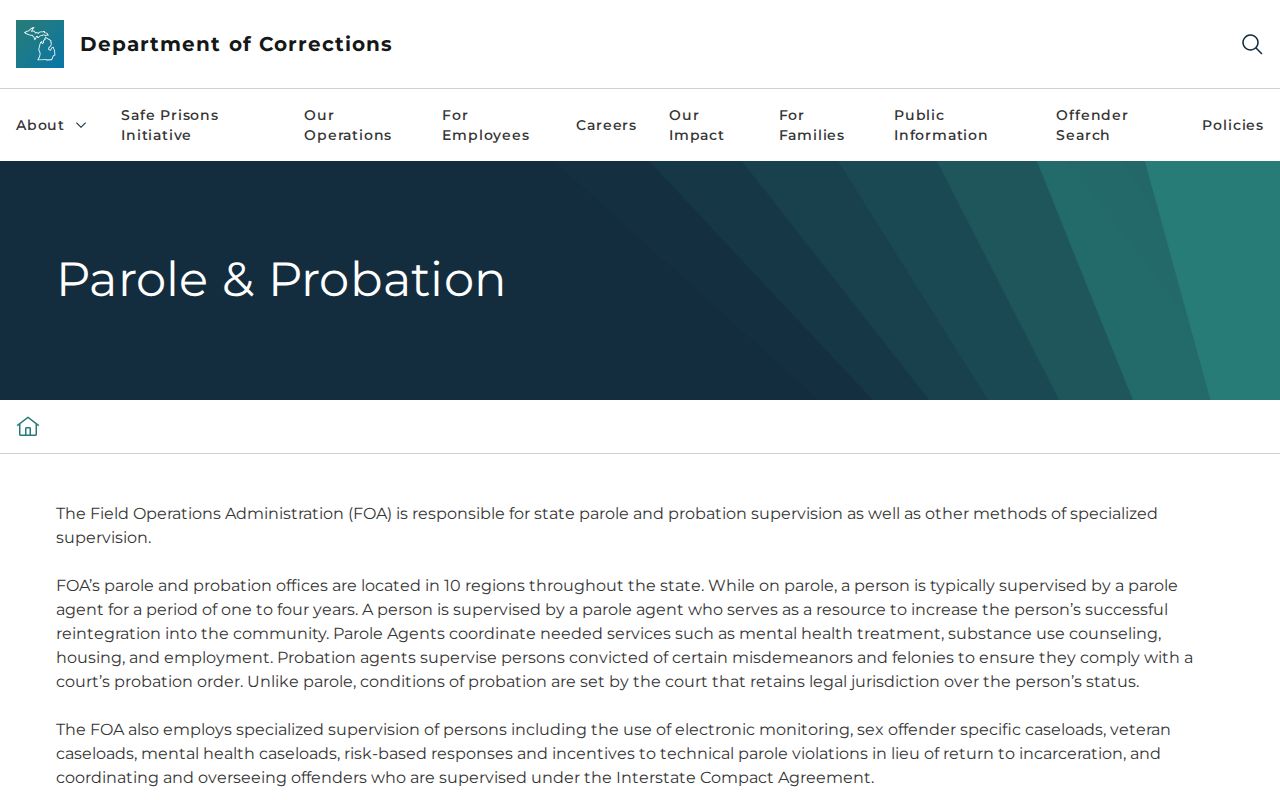
The directory supports office routing, but it does not replace the court judgment or promise disclosure of private supervision details.
Important: “Parole” confirms prison release and continued supervision. “Discharged” means MDOC jurisdiction for that displayed sentence has ended.
Two Iosco Supervision Offices
Iosco County has two concrete reporting doors, and they serve different case types. The combined state parole and probation office belongs to MDOC Region 3. It handles state parole and felony probation routing. The 81st District Court Probation Office handles the local misdemeanor layer. Its official instructions place the office in Room 116 and tell a reporting person to check at the District Court window if the officer is absent. Choosing the wrong office can delay a required report or lead to a false conclusion about status.
Iosco County Parole/Probation
MDOC Region 3
Courthouse Annex
420 W. Lake Street
P.O. Box 397
Tawas City, MI 48763
(989) 362-2966
81st District Court Probation
Iosco County Building, Room 116
422 W. Lake Street
Tawas City, MI 48763
Check at the District Court window if the probation officer is absent.
The district office's page names a probation officer/deputy magistrate and a probation compliance officer, but the court docket remains the source for the judgment and conditions. The MDOC office can route state-supervision questions and help address supervision-related OTIS errors. Neither office should be expected to release confidential case information merely because someone calls.
Note: Confirm the case level before visiting, since Iosco district probation and MDOC field supervision serve different judgments.
Iosco Parole Hearing Records
Parole eligibility is not a release order. The Michigan Parole Board considers felony offenders committed to MDOC after the applicable minimum term and legal credits. Michigan does not publish a full calendar of ordinary parole interviews, and not all hearings are public. The official Public Hearing Registration page and event notices cover selected lifer and clemency matters. Registration closes no later than two business days before a listed event.
The public page shown below is an event-driven access point, not a weekly list or person-by-person decision search. Consult the official hearing registration source for current notices.
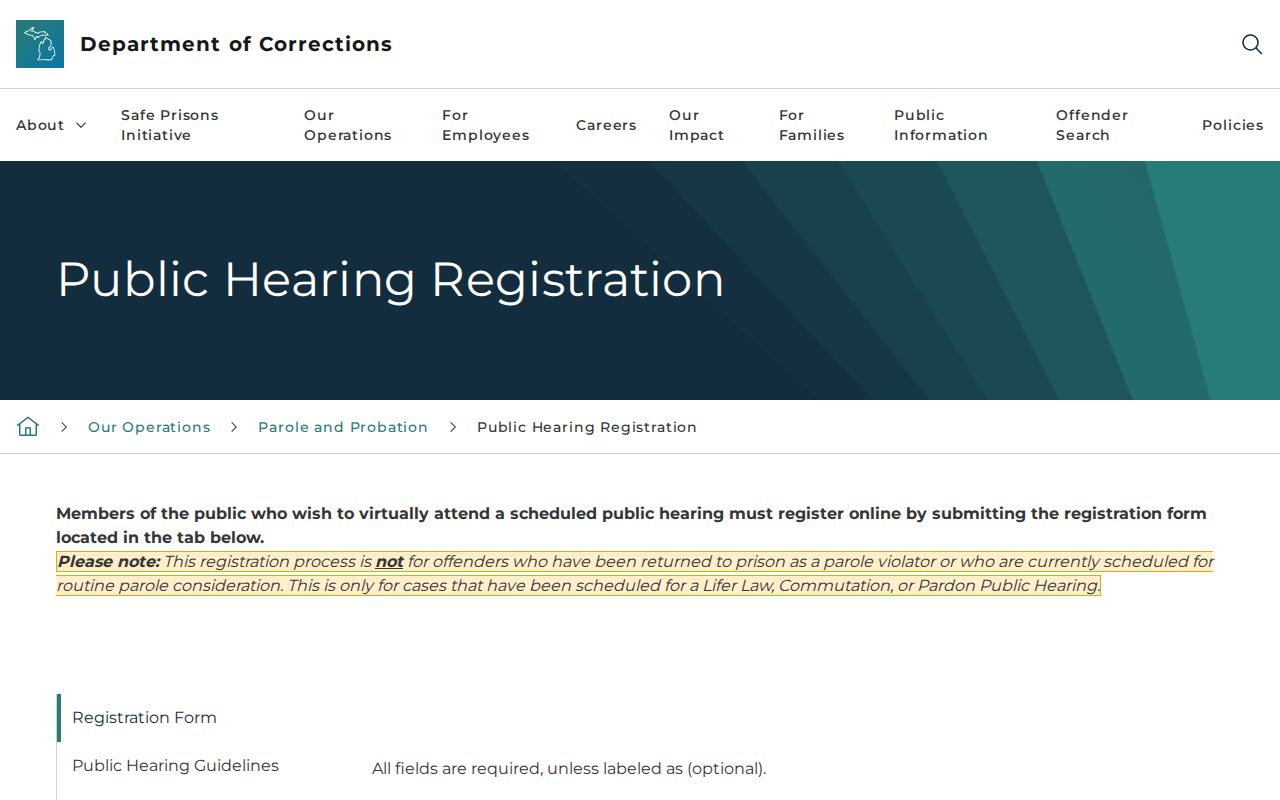
Official guidelines prohibit recording, photography, and screenshots of the live proceeding, so only the schedule and registration material should be preserved.
Quarterly decision reports separate paroles ordered from actual movement to parole. That distinction matters. An order can precede physical release while planning and processing occur. A continuance also is not automatically a denial. For a named person, use a qualifying public notice when one exists, then check DATE PAROLED and PAROLE status in OTIS after the event.
Iosco Supervision Absconder Status
OTIS distinguishes two absconder codes. ABSCOND1 identifies a parole absconder actively sought by MDOC. ABSCOND2 identifies a probation absconder under the sentencing county's jurisdiction. Neither label describes a successful discharge. It signals that required supervision contact has broken down and that the appropriate authority is following the case.
MDOC directs information about a parole absconder to local law enforcement or its Absconder/Escapee Tip Line at 517-755-0855. The Iosco County Sheriff’s Office says its Control Center maintains county warrants and assists in locating parole violators, but no searchable local warrant list is published. A warrant and an OTIS absconder status are related records, not interchangeable proof. Confirm the exact agency and case before reporting information.
MI-VINE can send participating custody-change alerts, including release, transfer, and escape, but it is not a supervision-condition database. Direct victims seeking state parole hearing or decision notice use the separate MDOC Crime Victim Notification Unit. General users should not infer a violation from a missing alert.
Note: An absconder label marks unresolved supervision contact; it does not prove a new conviction or a completed discharge.
Iosco Work Release Is Custody
Visible movement outside the Iosco County Jail, operated by Sheriff Scott D. Frank’s office, can create a false release assumption. The jail lists AA, GED, religious study, and a sheriff work program among its programs. Work-release privileges require both a court grant and sheriff authorization. A participant may leave the building for approved work while still being legally held by the jail.
That distinction is local and practical. A person seen at work has not necessarily been discharged, placed on parole, or put on probation. Verify present lodging through the Sheriff's Control Center and use the court or release record to identify the legal event. Transfers, court appearances, hospital movement, and another agency's handoff also differ from community release. The broader Iosco County released inmate search explains how county, court, and state records fit together after someone leaves the roster.
A court order may authorize temporary work movement without ending the jail sentence. By contrast, parole begins only after physical release from MDOC prison, and probation comes from a court judgment. The terms must not be substituted for one another.
Iosco Release Property and Errors
Iosco's official jail material says money received at intake enters an inmate trust fund. Personal property is recorded and stored in an assigned locked locker. The county does not publish the release pickup procedure, exit location, or timing. A person expecting property should contact the jail instead of assuming that every item is handed over through one automatic process.
Record corrections follow the source of the data. MDOC says much OTIS information begins with court records. A court-related error should be raised with the sentencing court. A supervision error, including an incorrect field-office or absconder entry, should go to the Iosco MDOC parole/probation office. The OTIS landing page also lists correctionsinfo@michigan.gov for inaccurate, outdated, or incomplete public information and mdocwebmaster@michigan.gov for technical faults.
Property questions and status corrections belong to different offices. The jail controls stored intake property. The court controls its judgment. MDOC controls its supervision record and can correct OTIS when directed by the court or supervising agent. Keeping those lanes separate helps avoid delay.
Note: Ask the jail directly about release property because Iosco publishes intake storage rules, not a standard pickup schedule.
Iosco Supervision Ends at Discharge
Physical release and legal discharge are separate milestones. DATE PAROLED records the date a person left state prison on parole. PAROLE as a current status means the person still serves the sentence under MDOC supervision. DISCHRG means MDOC jurisdiction has ended for the displayed sentence. The MDOC material notes that this label can follow successful parole or probation completion, discharge at the maximum without parole, or death before completion, so the detail and dates must be read together.
OTIS keeps discharged people in its public system only for three years after supervision discharge. An older missing result does not erase the record. MDOC FOIA, a PENPACK record, or the sentencing court may be needed for an official or older history. A PENPACK can include the judgment and discharge certificate among other certified materials.
When a current status is disputed, save the lookup date and the unique MDOC number. Compare the court judgment, OTIS fields, and supervising office. For local district probation that OTIS never covered, use the 81st District Court record. This source-by-source check is the sound way to establish whether Iosco County parole or probation remains active.