
Iosco Projected and Actual Release
Michigan uses date labels that are more exact than the common phrase “projected release date.” On a state OTIS record, the Parole Board Jurisdiction Date is the Earliest Release Date, often shortened to ERD. It marks the point when the Parole Board can gain jurisdiction, subject to the sentence and legally applicable credits. The Maximum Date is the potential end of the maximum sentence. DATE PAROLED records when the person actually left prison on parole.
Those three points must not be collapsed into one date. ERD is eligibility. It is not a booked exit, guaranteed parole, or proof that release occurred. A maximum date is another possible endpoint if parole does not occur first. DATE PAROLED is an event field, and a discharge record can confirm the later end of MDOC jurisdiction. The state record should be preserved with the lookup date because the status may change.
Scheduled versus actual: An eligibility or maximum date describes a legal milestone. DATE PAROLED or an official release record documents the physical event.
A pretrial detainee in Iosco County Jail is different. No sentence calculation can supply a set date before the court acts. Bond, dismissal, a plea, a sentence, a transfer, or another order may change custody. Even for a county jail sentence, the sheriff and court apply the judgment, jail credit, and holds. OTIS should never be used to estimate a jail-only term because MDOC expressly excludes county-jail-only prisoners.
Find an Iosco Projected Release Date
Begin with the agency that has legal custody. For an Iosco County Jail detainee, call Sheriff Scott D. Frank’s office at (989) 362-6164 and ask whether the person is presently lodged. That narrow answer does not state when or why someone left. Use the 81st District Court or 23rd Circuit Court record for the governing order, then request the release sheet or custody-event record from the sheriff when an exact event matters.
For a Michigan prisoner, parolee, or MDOC probationer, use the MDOC OTIS landing page. Search by MDOC number when known. Otherwise use at least a last name and compare other identifiers before opening a detail record. The practical sequence is:
- Decide whether the person is in county jail, state prison, community supervision, or another system.
- For a state case, open OTIS and search by MDOC number or a carefully matched name.
- Read status, location or supervision, sentence entries, Earliest Release Date, Maximum Date, and DATE PAROLED together.
- For a county case, review the court chronology and ask the jail for the computed release or an existing release record.
- Check for later orders, transfers, detainers, or data corrections before treating a displayed date as current.
- Confirm a completed event with the agency record rather than relying on the earlier estimate.
MDOC's public FAQ is one official source for the minimum and maximum date framework. Review the MDOC release-date explanations shown here before interpreting a state sentence.
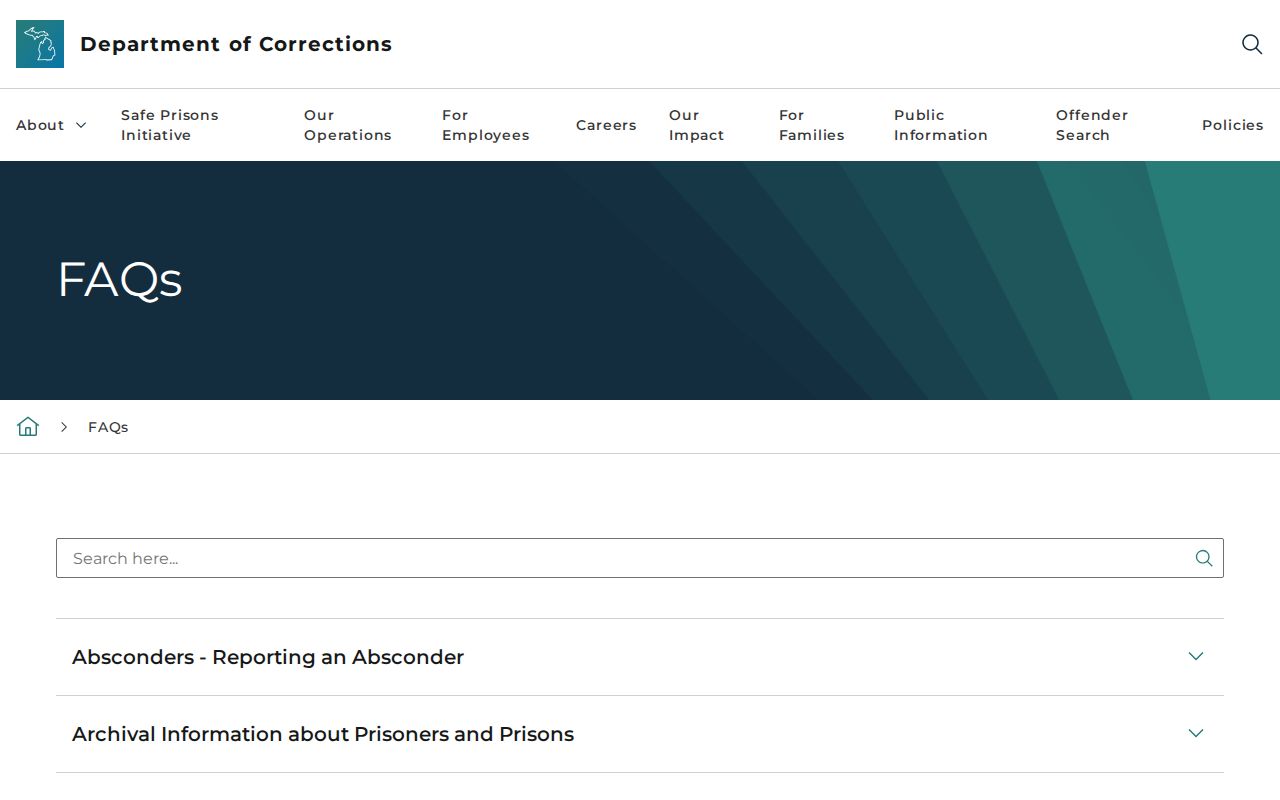
The FAQ explains state sentence dates, while the Iosco court and sheriff remain the correct sources for a jail-only case.
Note: A person missing from the current jail information is not proven released; a transfer or other movement may explain the change.
Iosco Release Fields in OTIS
OTIS covers people currently under MDOC jurisdiction and discharged people who remain within three years of supervision discharge. It excludes city lockup and county-jail-only sentences. That boundary is essential for an Iosco release-date search. A no-result may mean the person was never under MDOC, discharged outside the display period, or was not matched correctly.
The official OTIS field definitions pictured below show how Michigan labels dates and status.
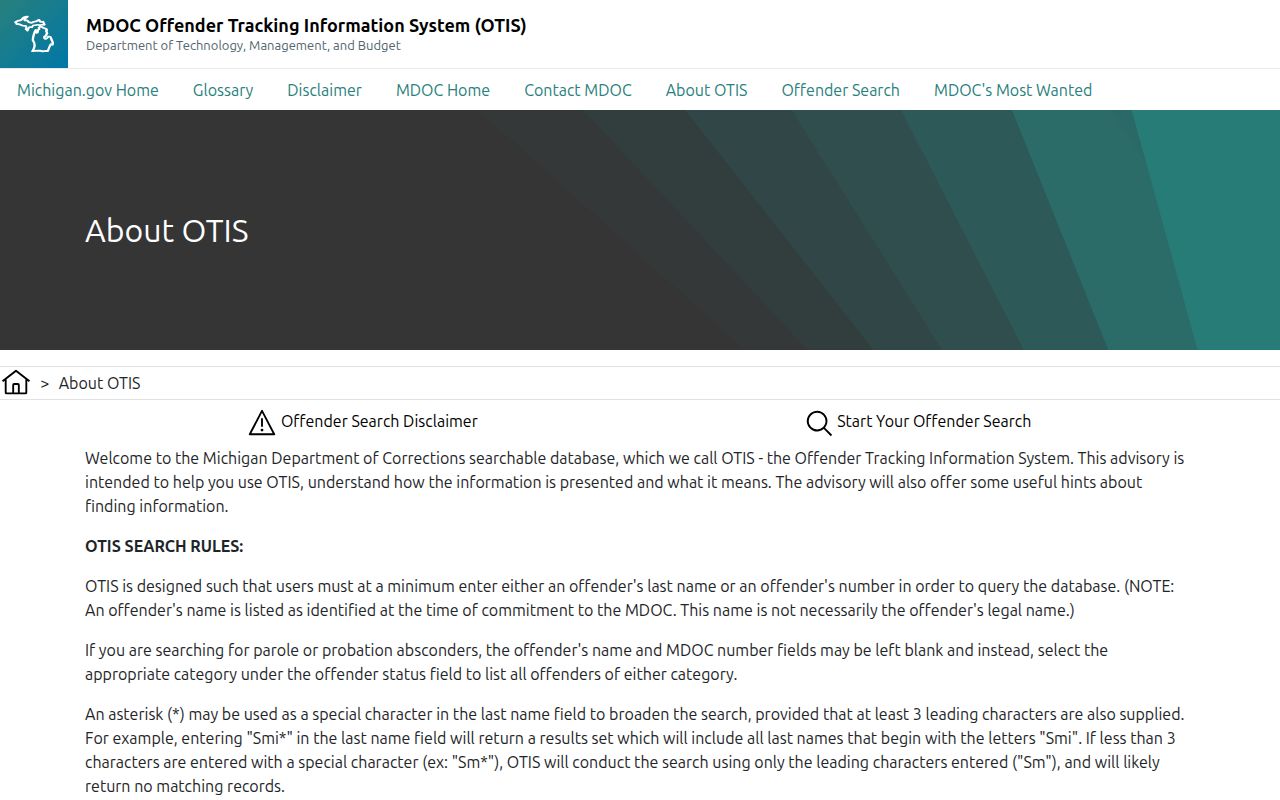
These definitions prevent an ERD from being mistaken for a promised release date.
| OTIS field | What it establishes | What it does not establish |
|---|---|---|
| Parole Board Jurisdiction Date / ERD | The first parole eligibility point under the sentence and applicable credits | A guaranteed or scheduled release |
| Maximum Date | The potential end of the maximum term, with applicable rules | That the person must remain until that date |
| DATE PAROLED | The date of actual movement from prison to parole | The later end of supervision |
| PAROLE status | Release from prison with continuing MDOC jurisdiction | Full discharge from the sentence |
| DISCHRG status | MDOC jurisdiction ended for the displayed sentence | One universal reason for discharge |
Read offense and sentence rows as well as the headline status. Most Michigan prison sentences are indeterminate, with a minimum and a maximum. The Parole Board may release an eligible person at the ERD or later before the maximum, but eligibility does not force a grant. If there is no parole, discharge may occur at the maximum endpoint.
Iosco Release and Truth Sentencing
Michigan Truth in Sentencing is not a general rule that prisoners serve 85 percent. For covered crimes, MDOC states that the person must serve 100 percent of the judicial minimum in prison before parole consideration. The rule applies to specified assaultive crimes committed on or after December 15, 1998, and other covered crimes committed on or after December 15, 2000. It removed good time, disciplinary credits, and corrections-center placement as ways to shorten that minimum.
This statewide rule is the key computation quirk for an Iosco state-prison case. Review the MDOC Truth in Sentencing explanation shown below.
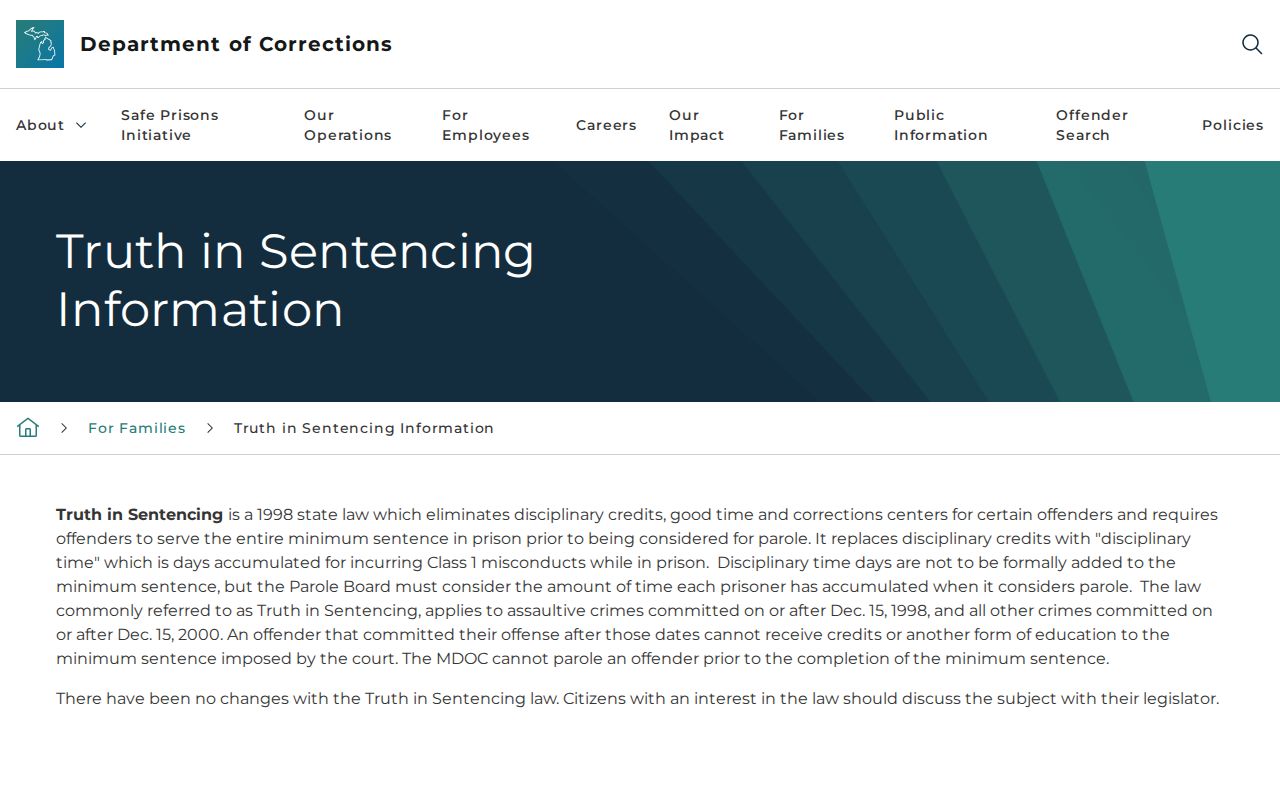
The official source confirms that the covered minimum is served in prison before eligibility, not reduced by a blanket percentage calculation.
MCL 791.234 governs parole eligibility and Board jurisdiction across several offense and date categories. MCL 791.233 addresses parole authority. The Board must apply the statutory standard; becoming eligible does not command it to grant release.
MDOC also requires at least 28 days between a Board release decision and physical release so release planning can occur. An order and actual movement to parole are distinct events. DATE PAROLED is therefore more useful than the order date when the question is when the person left prison.
Note: Michigan’s covered judicial minimum is served at 100 percent; the common 85-percent shortcut is not the state rule.
Legacy Credits and Iosco Release
Older Michigan offenses may follow a different credit system. Pre-Truth-in-Sentencing prisoners can have traditional good time or disciplinary credits based on the crime date and governing law. MCL 800.33, related legacy provisions, and MDOC Policy Directive 03.01.101 control those calculations for eligible cases.
The official material describes disciplinary credits in general as five days per month, with up to two more days for exceptional behavior in eligible cases. Credits can be lost. That summary is not a formula to apply to every record. Offense date, statute, sentence structure, misconduct, and the specific MDOC calculation determine whether the rule applies.
“Disciplinary time” under the newer framework also should not be treated as a simple number added to the minimum. MDOC explains that Class I misconduct is considered by the Parole Board, rather than automatically extending every judicial minimum in the way a reader may expect. Request an official MDOC explanation or record when a legacy computation is unclear.
Iosco Jail Release Date Limits
The Iosco County site does not publish a county good-time calculation or a weekend and holiday early-release rule. It would be inaccurate to copy an MDOC ERD into a jail-only case. The court judgment, credited jail time, applicable Michigan jail law, other holds, and the sheriff's computation control the date.
For a sentenced jail inmate, ask the sentencing court for the judgment and check the custody credits it records. Then call the jail for the current calculation or request the existing release sheet. For a pretrial detainee, follow the docket for a bond order, dismissal, plea, sentencing, or transfer. Bond may be posted through Iosco around the clock for eligible local and in-state charges, so current lodging can change outside normal court hours.
A court order may authorize work release without ending custody. A transfer to MDOC, another jail, federal custody, treatment, or another authority also is not community discharge. The release record should state the actual time, release type or disposition code, authorizing court or agency, and destination when those fields are releasable. The Iosco County released inmate record paths cover that release-sheet request in more detail.
County-jail limit: No official Iosco good-time or weekend-release formula is published, so ask for the court and jail calculation.
Why Iosco Release Dates Change
A date can move for legal, custodial, or data reasons. Preserve the date when a lookup was made, because an updated order or correction may alter the public display later. One change may affect the minimum, another the maximum, and another only the physical movement date.
| Factor | Possible effect | Record to check |
|---|---|---|
| Amended judgment or appeal | Changes the sentence or credited time | Sentencing court docket and order |
| Consecutive or concurrent terms | Changes how multiple sentences combine | Judgment and MDOC sentence detail |
| Legacy credit gain or loss | Alters eligible older calculations | MDOC sentence computation |
| Parole denial or continuance | Leaves the person in prison after eligibility | Board process record and later OTIS status |
| Detainer or agency hold | May cause transfer instead of community release | Holding and receiving agency records |
| Data correction or recalculation | Updates a previously displayed field | OTIS, court, and MDOC confirmation |
A detainer is a request or legal hold from another authority. It can change the destination without changing the fact that the person left the first facility. Likewise, a parole denial leaves an eligible person in prison, while a continuance postpones final action. Neither should be called release.
Note: Save the lookup date and identifier so a later OTIS or court update can be matched to the same person.
Confirm an Iosco Release Date
A pending date and a completed event require different tools. OTIS shows Michigan prison status and sentence dates. The Iosco Sheriff and court establish a county-jail event. MI-VINE can send a timely custody-change alert from a participating agency, but the service warns that data may not be complete or current and does not issue a certified release record.
For a state prisoner, confirm actual movement through DATE PAROLED and the current PAROLE status, then seek MDOC records when formal proof is needed. For a county case, request the release sheet and compare it to the court order. If another agency received the person, continue with that agency because leaving one facility under a hold is a transfer.
The Iosco VINELink release check is useful before an expected event because notifications can be registered for a specific matched person. After an alert, verify the time, reason, and destination with the reporting jail or MDOC. That final source check is what turns a projected Iosco inmate release date into a confirmed event.